Research
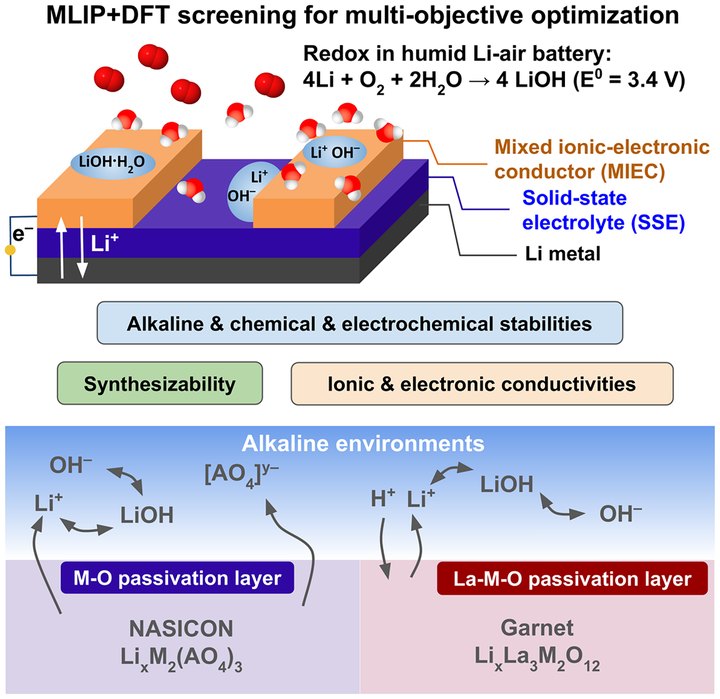
We combine machine-learning models with atomistic simulations to understand ion transport in energy materials and to find new battery materials. The work spans inorganic crystals, amorphous solids, polymers, and liquids.
- AI-driven autonomous materials discovery for batteries
- Machine-learning interatomic potentials and accelerated simulation
- Ion transport mechanisms in superionic conductors
- Mechanistic decomposition of transport in liquid, polymer, and amorphous electrolytes
- High-throughput and machine-learning-guided materials discovery
AI-driven autonomous materials discovery for batteries
How can machine-learning models, simulations, and experiments be connected so that each round chooses the next material to make and test?
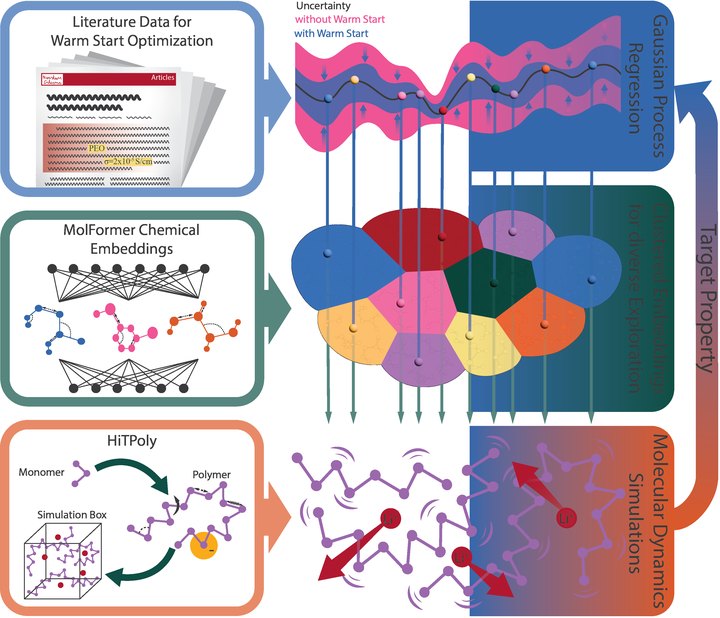
We build decision loops in which a model proposes candidate materials, simulations or experiments evaluate them, and the results update the model for the next round. The target is battery materials such as solid and polymer electrolytes, where the search space is too large to cover one sample at a time.
Methods
- Bayesian optimization and active learning
- High-throughput simulation as a surrogate for experiments
- Closed-loop coupling with automated synthesis and testing
Representative papers
Machine-learning interatomic potentials and accelerated simulation
How can simulations keep first-principles accuracy while reaching nanosecond time scales and nanometer length scales?
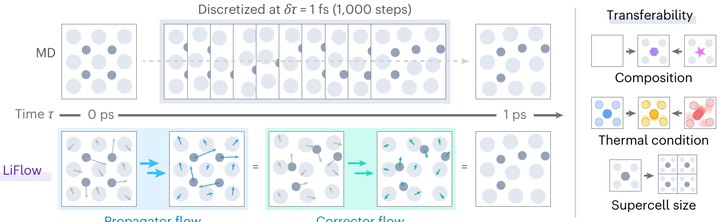
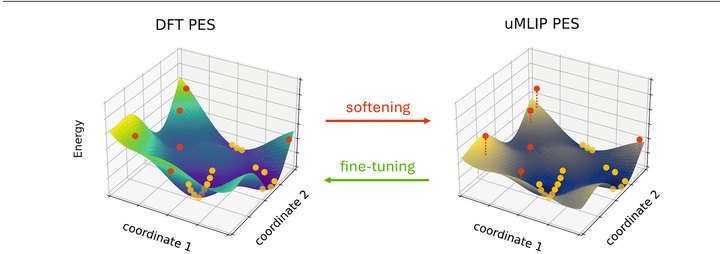
We develop, fine-tune, and test machine-learning interatomic potentials, and use generative models to accelerate molecular dynamics, so that transport in disordered and complex materials can be simulated directly.
Methods
- Universal and fine-tuned machine-learning interatomic potentials
- Generative models for accelerated dynamics
- Free-energy methods
Representative papers

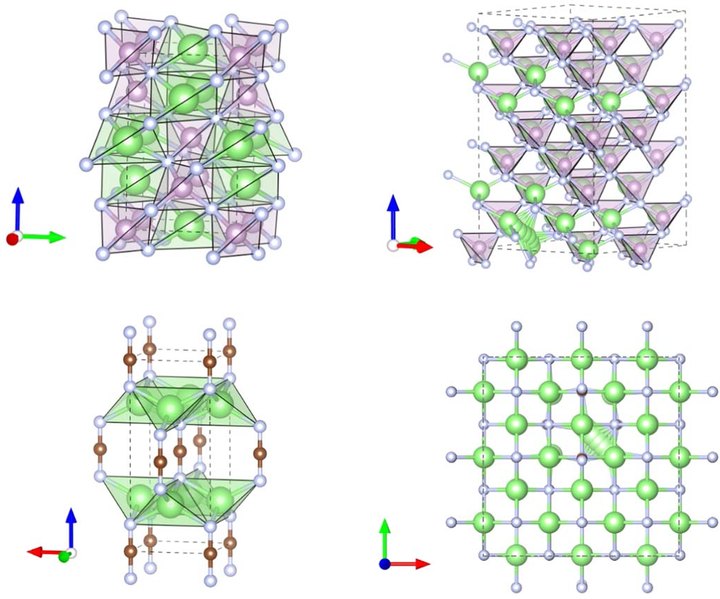
Ion transport mechanisms in superionic conductors
Why do some crystal structures conduct Li and Na ions orders of magnitude faster than others?
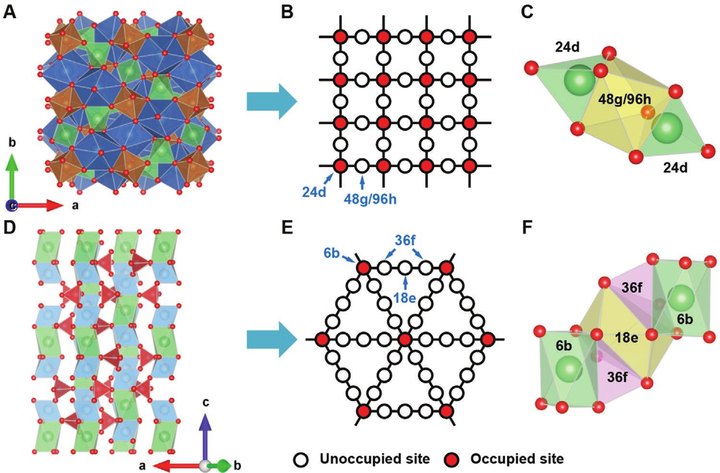
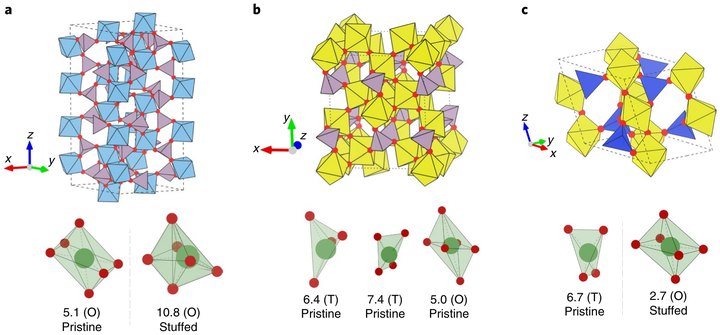
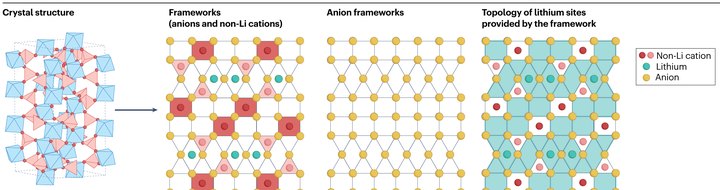
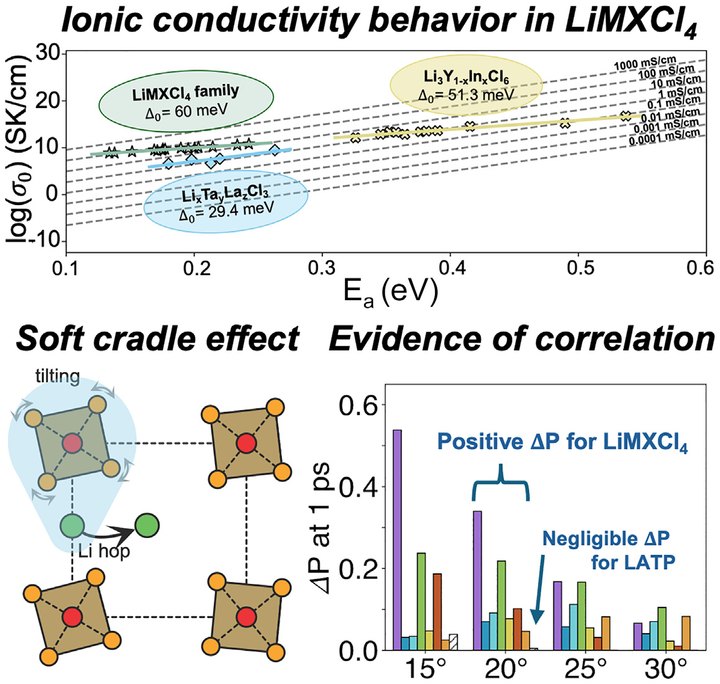
We study how the framework of a crystal (corner-sharing polyhedra, anion-group rotation and tilting, van der Waals gaps) sets the energy landscape for ion hops, and turn these findings into design rules for new solid electrolytes.
Methods
- Ab initio and machine-learning molecular dynamics
- Algorithms that detect correlated ion hops and anion-group motion
- Structure–property analysis across material families
Representative papers
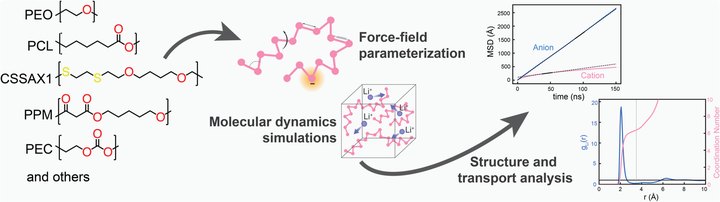
Mechanistic decomposition of transport in liquid, polymer, and amorphous electrolytes
Which microscopic events carry the charge in an electrolyte, and how much does each contribute to the measured conductivity?
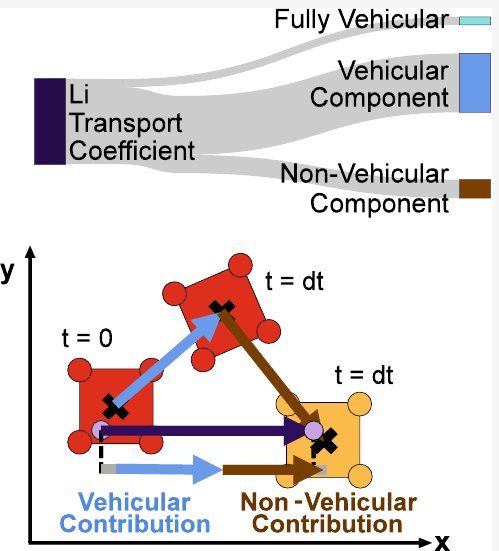
We develop analysis methods that split the ionic conductivity from a simulation into contributions from single-ion hops, correlated hops, and vehicular motion. The same framework applies to inorganic crystals, liquids, and polymers.
Methods
- Event detection in molecular dynamics trajectories
- Decomposition of Onsager transport coefficients into additive contributions
- Large-scale classical and machine-learning molecular dynamics
Representative papers
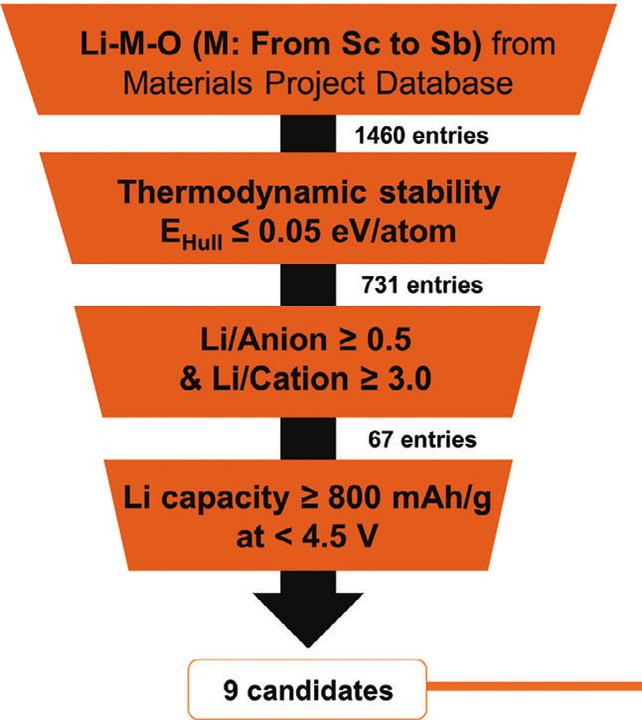
High-throughput and machine-learning-guided materials discovery
Which compositions are fast ion conductors and remain stable under operating conditions?
We screen large sets of candidate compounds for ionic conductivity and stability, and work with experimental groups to synthesize and test the predictions. Targets include solid electrolytes, mixed ionic–electronic conductors, and cathode additives.
Methods
- First-principles calculations (DFT)
- Machine-learning screening of large candidate sets
- Stability analysis (phase diagrams, electrochemical windows)